You can reach Bydgoszcz in many different ways. It is easy to arrive by car or by train, and the city also has an airport located fairly close to the center.
Day I
During the Christmas season, visiting the Christmas market – both during the day and in the evening – is almost a must. In every setting, it looks truly magical.
Bydgoszcz is a city on the water, so it is worth taking a cruise. Although the offer is limited in the autumn–winter period, you can still sail on one of the newest additions to the Bydgoszcz fleet, the Wenecja. Reservations and tickets are available on the website: https://rejsybydgoszcz.pl/produkt/bilet-na-rejs/
While near the Old Market Square, it is worth visiting the Bydgoszcz Cathedral, distinguished by the painting of Our Lady of Beautiful Love, also known as the Madonna with a Rose. The exact history of this painting is unknown, but it is estimated to date back to the 15th century. The history of the church itself goes back to the 14th century, when a wooden temple was built. It was destroyed in the fire of 1425. In the same year, reconstruction began and was completed in 1466, giving the cathedral a shape similar to what we see today. The present-day cathedral was later expanded on several occasions. The cathedral bells come from Kamieniec Podolski and arrived in Poland after 1920 under the terms of the Treaty of Riga. The cathedral aligns beautifully with the Brda River, but to appreciate this, it is worth crossing to the other side of the river.
In 2018, during the renovation of the presbytery, archaeological work uncovered a large treasure consisting of coins and jewelry dated to the turn of the 15th and 16th centuries. Most likely, someone hid them this way, but the mystery remains unsolved to this day. The restored treasure can be viewed on Mill Island in the European Money Center, operated by the Leon Wyczółkowski District Museum.
While in the city center, it is also worth visiting the Church of the Assumption of the Blessed Virgin Mary from the 16th century, popularly called the Clarist Church. The nickname comes from the Order of the Poor Clares, who arrived in Bydgoszcz in the 17th century. The order was dissolved in the 19th century, and the church was secularized. Since 1993, the pastoral work here has been carried out by the Capuchin Friars, following the rule of St. Francis.
While staying in Bydgoszcz, one should also visit Mill Island, adjacent to the Old Town, as well as the characteristic Rother’s Mills. It is indeed an island, surrounded on one side by the Brda River and on the others by the Młynówka. Some people refer to this area as the Bydgoszcz Venice. Rother’s Mills were originally built in the early 19th century as a grain storage facility, as Bydgoszcz was an important center of water trade. After recent revitalization, it now serves as an exhibition space.
Day II
On the second day of your visit, we encourage you to explore areas beyond the strict city center. On the southern side, you will find Dąbrowski Hill, which references the Kościuszko Uprising. At the beginning of the 20th century, a Water Tower was built there to support the local waterworks. Today, it houses a waterworks museum, where temporary exhibitions by local artists are also held, along with a unique viewing point.
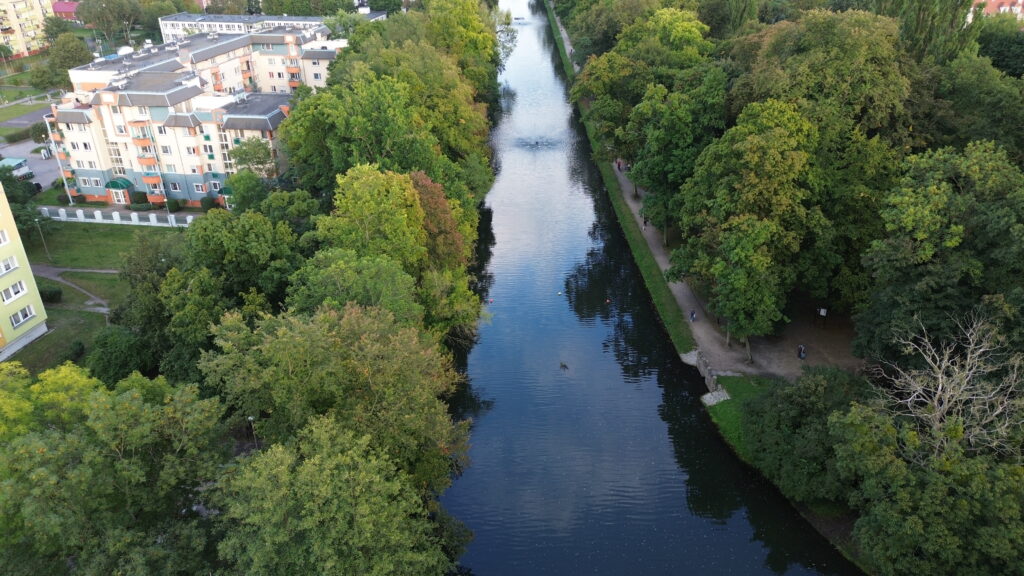
Northwest of the center, you can reach the Green Belt along the Bydgoszcz Canal. This is the old route of the canal, which has not been used as a waterway for over a century. The trees planted along it have created an exceptional recreational area. It is truly a gem on a global scale-a place where you can wind down and experience something interesting in almost every season.
Nawet zimą jest tu klimatycznie.
If time allows, it is worthwhile to visit the Exploseum, a museum located in a former German nitroglycerin factory from World War II. If you enjoy the atmosphere of that historical period and the industrial architecture presented in a modern form, this is an absolute must-see on your sightseeing map.
Używamy plików ciasteczka, aby zapewnić Ci jak najlepsze wrażenia z korzystania z naszej witryny. Jeśli nadal będziesz korzystać z tej witryny, będziemy zakładać, że jesteś z niej zadowolony.